Help · Money
Tax invoice numbers
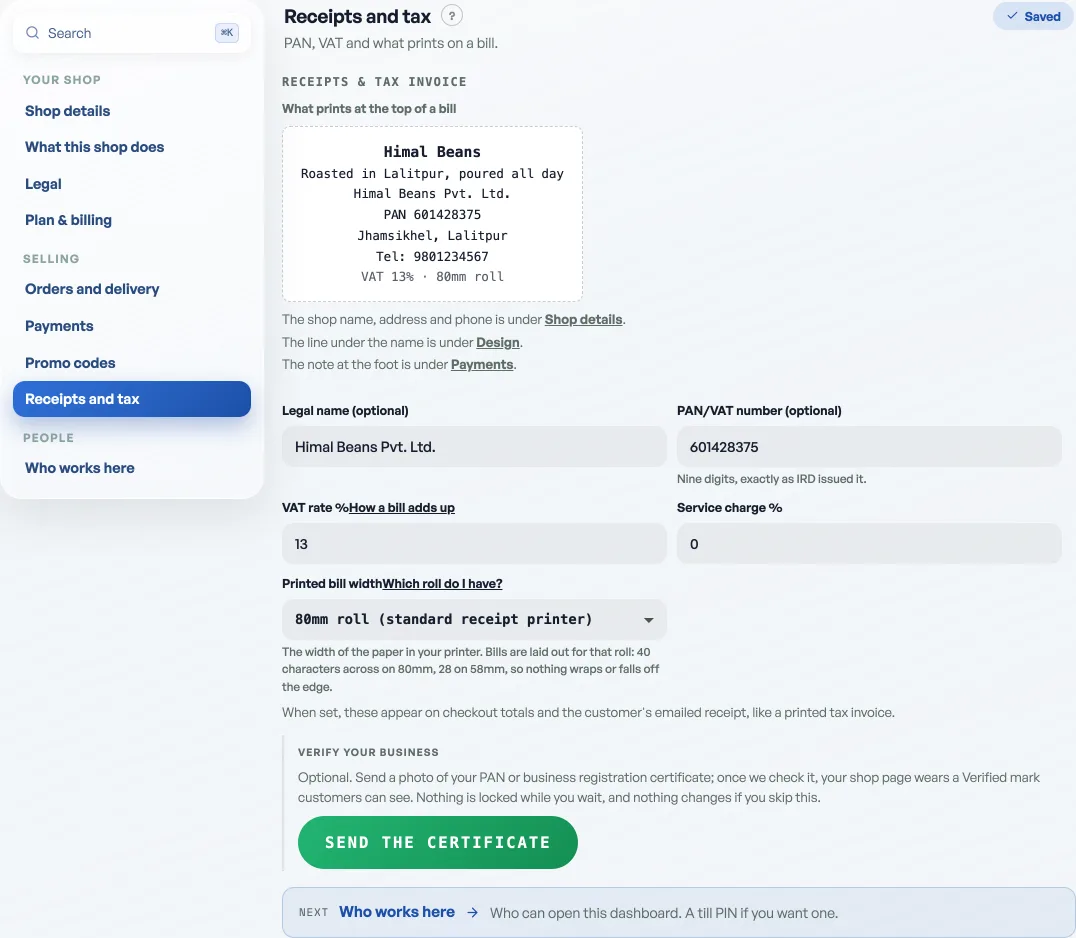
Fill in your PAN and every paid order gets a numbered tax invoice, counting up from 1 each Shrawan.
An order number like PSL-D4QWN8 tells you which sale it is. It does not tell anyone how many sales came before it. A tax office wants the other thing: a run of numbers that starts at 1 and counts up with nothing missing, so a sale left out of the books shows up as a gap.
- Open Shop profile, then Receipts and tax under Selling, and fill in your PAN/VAT number.
- Carry on as normal. From then on, every order you mark paid is given the next number in your series and its document reads Tax invoice.
What a number looks like
2083/84-0001. The first part is the Nepali fiscal year, which runs from Shrawan to Ashad. The second is where this sale sits in that year. Every Shrawan the count starts again at 0001 in the new year, exactly as your books do. The number is yours alone: another shop on Pasal has its own 0001.
You can find a sale by it. Type the number into the search box on the Orders tab and the order comes up, which is the question an accountant actually asks: not "which order was this", but "which sale is 2083/84-0042".
No PAN means no number, and that is correct
A shop with no PAN on file cannot issue a tax invoice, so its paid orders get a Payment receipt instead, with no number on it. That is a real document and it is not a fault. It says plainly that it is not a tax invoice, because a blank PAN might mean you are not registered or might mean nobody has typed it in yet, and a piece of paper cannot tell those apart.
Type your PAN in next Baisakh and your series still starts at 0001, with your first real tax invoice. It does not start at 84 with 83 documents behind it that were never given to anybody.
The number is written once
- It is given when the money arrives, not when the order is placed. An order nobody ever pays for takes no number, so it leaves no hole.
- It never changes. Reprint the bill in five years and it reads exactly as the customer's copy does. Send the receipt again and it carries the same number, because two numbers for one sale is the thing numbering exists to make visible.
- An invoiced order cannot be deleted. Pasal refuses, and says so. Cancel it or refund it instead: both keep the row, and a hole in the middle of the series is exactly what the numbering is for. See Cancelling an order.
- Cancelled and zero-total orders take no number at all, because no document is ever issued for them.
A sale rung on the counter while the internet was down prints as a payment receipt, because the number is given by Pasal and that counter is not talking to Pasal yet. The moment it syncs, the sale gets its number and the customer's emailed copy carries it.
- Tax invoices and sales recordsPAN/VAT invoices and a record of every sale for your accounts.
- Check the month's takingsThe Bills tab month by month: what counts as paid, what is still owed, and the spreadsheet for your accountant.
- The pack to hand your accountantSales, spending and wages for a period, on four panes, each with a download. It reads and exports, and writes nothing.